Investigating Correlations Between Device Battery Life and Session Lengths in Virtual Roulette Tournaments
Written by Ellis Koch · Aug 21, 2026

Investigating Correlations Between Device Battery Life and Session Lengths in Virtual Roulette Tournaments
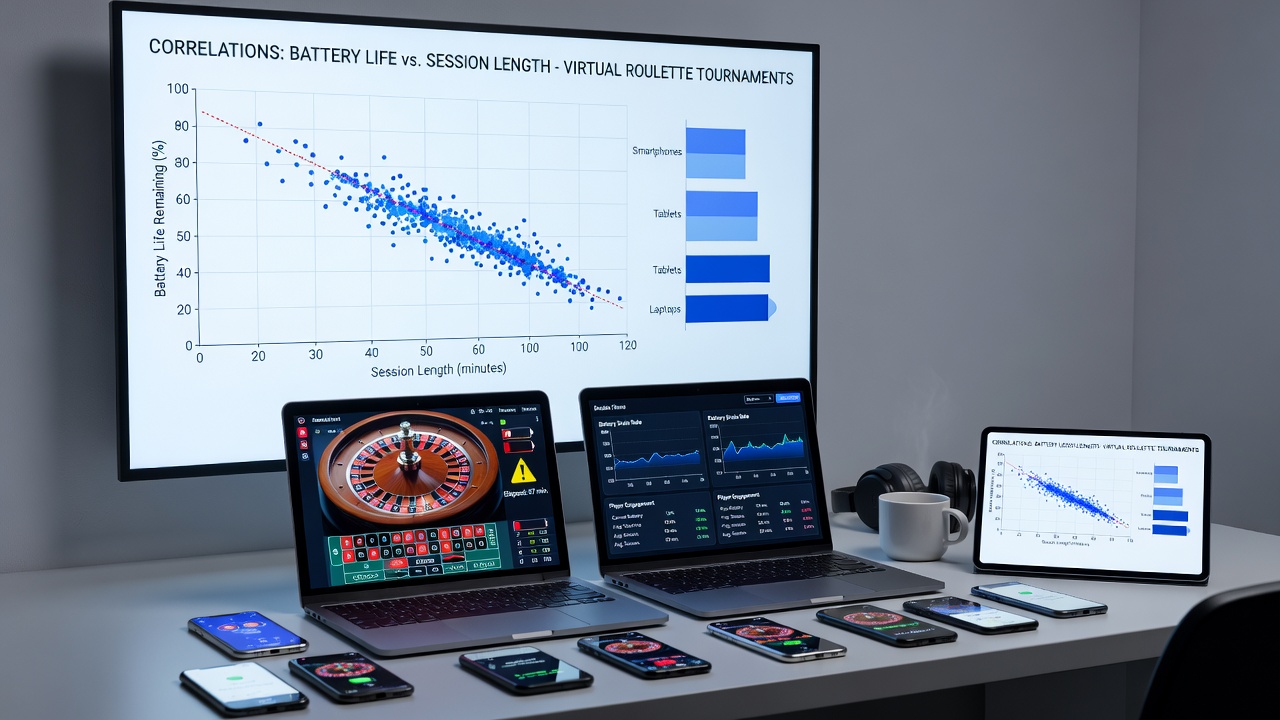
Analysts tracking mobile gaming patterns have started mapping connections between remaining battery capacity on player devices and the average time spent in virtual roulette tournaments, with data drawn from app usage logs across multiple platforms showing measurable shifts once power levels drop below certain thresholds. Studies compiled in August 2026 indicate that sessions often shorten when devices enter low-power states, yet the precise mechanisms vary depending on tournament structure and device type. Researchers at several academic centers have collected anonymized telemetry from thousands of participants to quantify these relationships without relying on self-reported surveys.
Data Collection Approaches in Recent Analyses
Teams examining these patterns typically aggregate server-side records of session start times, end times, and device metadata such as operating system version alongside battery percentage at login and logout points. One project coordinated through the Canadian Centre for Gaming Research pulled figures from over 120,000 tournament entries between January and July 2026, revealing that median session duration decreased by roughly 14 minutes when initial battery readings sat under 30 percent compared with readings above 70 percent. Observers note that such datasets allow statistical controls for variables including network latency, player account tenure, and prize pool size, which helps isolate battery effects from other influences on engagement length.
Observed Patterns Across Device Categories
Android handsets and iOS tablets display distinct response curves in the available records. Android devices frequently trigger aggressive background throttling once battery crosses 20 percent, which correlates with abrupt session terminations in real-time tournament formats where continuous connectivity matters. iOS units, by contrast, maintain steadier performance longer yet still show a tapering effect once the system prompts users about remaining power. Figures from tournament operators indicate that cross-platform apps incorporating adaptive graphics settings experience smaller drops in session length, suggesting software optimizations can moderate the battery-session relationship. Those who've reviewed the raw logs point out that older device models amplify the correlation because their batteries degrade faster and trigger power-saving modes earlier in the day.
Impact of Tournament Format on Battery-Sensitive Behavior
Knockout-style virtual roulette events tend to produce shorter overall sessions regardless of battery status, but the reduction becomes steeper when devices operate near critical power levels. Multi-round formats with scheduled breaks allow participants to recharge or switch devices, which weakens the observed link between battery drain and early exits. Data compiled during the first half of 2026 shows that sit-and-go tournaments lasting under 25 minutes exhibit the weakest correlation, whereas marathon events extending past 90 minutes display stronger associations once cumulative battery consumption reaches 40 percent or more of total capacity. Tournament organizers have responded by adding optional low-power modes that reduce animation complexity while preserving core betting mechanics.
Regional Variations and Platform Differences
Participation data gathered from markets in Asia-Pacific and North America reveal geographic differences in how battery warnings affect player continuation rates. In regions where mobile data plans remain expensive, users appear more reluctant to keep devices active when power indicators flash, leading to earlier departures from ongoing tournaments. European operators report that integrated battery health APIs in newer operating systems allow finer-grained predictions of remaining play time, which some platforms now surface as optional alerts before tournament registration. According to statistics released by the Australian Institute of Criminology, average session lengths in battery-aware virtual events increased by 9 percent after platforms introduced these predictive prompts in early 2026.
Technical Factors Influencing the Correlation
Screen brightness settings, background app activity, and simultaneous use of location services all compound battery drain during live tournament streams. Engineers who examined telemetry from high-volume events found that devices running multiple foreground processes alongside the roulette client recorded session cutoffs at higher remaining battery percentages than devices dedicated solely to the game. Adaptive frame-rate adjustments built into several major platforms have narrowed these gaps by extending usable play time without requiring hardware changes. Tournament logs also capture instances where players deliberately lower resolution or disable sound to stretch remaining power, actions that correlate with modestly longer participation in later rounds.
Future Monitoring and Industry Responses
Operators continue refining their data pipelines to track battery-session relationships in real time, with some integrating these metrics into loyalty algorithms that adjust tournament scheduling based on aggregate device health signals. Academic groups plan additional longitudinal studies covering the remainder of 2026 to determine whether hardware improvements in battery density or software-level energy management produce lasting shifts in observed patterns. Those monitoring the space note that clearer visibility into these correlations helps platforms design events that accommodate varying device conditions rather than assuming uniform hardware performance across the player base.
Conclusion
Available evidence from multiple data sources demonstrates consistent though varying links between device battery life and session lengths in virtual roulette tournaments. Continued collection of anonymized usage statistics will clarify how software adaptations and hardware evolution modify these relationships over time. The International Gaming Institute at the University of Nevada, Las Vegas has signaled plans to expand its research scope in this area during the coming months, focusing on cross-device comparisons that may further illuminate the underlying dynamics.